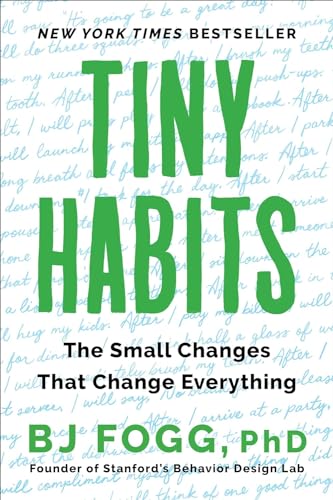
Tiny Habits
by BJ Fogg
star4.2
Fogg argues that lasting change comes not from motivation but from making behaviours tiny and anchoring them to existing routines. Start absurdly small and let momentum build naturally.
- Published:
- Pages:
- 320
by BJ Fogg
Fogg argues that lasting change comes not from motivation but from making behaviours tiny and anchoring them to existing routines. Start absurdly small and let momentum build naturally.
In this collection, Tiny Habits references 3 other books and is cited by 1 other book.
It draws on The Power of Habit, Thinking, Fast and Slow and Atomic Habits.
It’s picked up by Atomic Habits.
Scroll down to read the exact passages where other authors reference this book and what they say about it.
The books Fogg references and why each one mattered to the argument.
Fogg differentiates Tiny Habits from Duhigg's habit loop.
Fogg cites Kahneman on motivation and cognitive effort.
Fogg acknowledges Clear's Atomic Habits as building on his research.
The exact passages where other authors bring up “Tiny Habits” and what they take from it.
Clear credits BJ Fogg directly for the habit stacking idea: "In this chapter, I used the term habit stacking to refer to linking a new habit to an old one. For this idea, I give credit to BJ Fogg. In his work, Fogg uses the term anchoring to describe this approach."
Chapter 5 (notes)
How ideas flow through the citation network. Ancestors are books this title builds on; descendants are books that build on it.
Directly cites
Directly cited by
Books from completely different categories that share citation overlap with this one. These are the reads you would not find by browsing a single shelf.

Hooked
Nir Eyal
Wired for Story: The Writer's Guide to Using Brain Science to Hook Readers from the Very First Sentence
Lisa Cron
Sapiens
Yuval Noah Harari

Start with Why
Simon Sinek

Homo Deus
Yuval Noah Harari
Books with the highest citation overlap within the same categories.
This book and its direct connections. Hover a node to see its title, click to visit.
Hover a node to highlight its connections. Click to open the book page. Node size reflects total citation links.