A World Without Email: Reimagining Work in an Age of Communication Overload

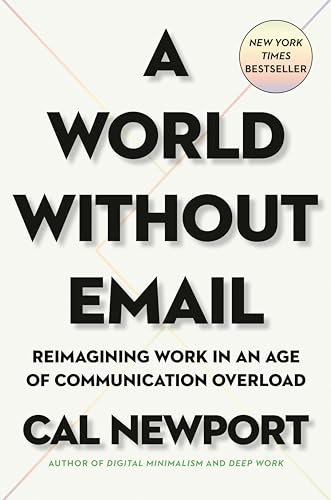
A World Without Email: Reimagining Work in an Age of Communication Overload

by Cal Newport

star4.4

Newport argues that the modern knowledge-work default of constant ad hoc email and chat, what he calls the hyperactive hive mind, is a historical accident that has destroyed our capacity for sustained thought and is the real cause of the productivity crisis in brain work. He proposes replacing ambient messageing with explicit processes, protocols, and specialization so that attention becomes the scarce resource workflows are designed around.

Published:
Pages:
320
Buy on Amazon

In the Conversation

In this collection, A World Without Email: Reimagining Work in an Age of Communication Overload references 13 other books.

It draws on Who Owns the Future?, Deep Work and Digital Minimalism.

Scroll down to read the exact passages where other authors reference this book and what they say about it.

What This Book Draws On

13

The books Newport references and why each one mattered to the argument.

Newport traces the origin of this book to encountering Jaron Lanier's Who Owns the Future? at a Barnes & Noble in Bethesda in 2015. "Standing there in the aisle, holding the book, a revelation hit me that all at once seemed to clarify the muddled mass of research and intuitions with which I'd been battling: What if work didn't require email?"

Acknowledgments

Who Owns the Future?

References

Who Owns the Future?

by Jaron Lanier

Buy

Deep Work is referenced throughout as the book's intellectual predecessor. Newport explicitly frames A World Without Email as the organisational counterpart to Deep Work — the latter focused on the individual, the former on the workflow structures that make deep work possible.

Throughout

Deep Work

References

Deep Work

by Cal Newport

Buy

Newport references his own Digital Minimalism (2019) as a complementary investigation into technology's effect on attention. Both books were sold to Portfolio at the same time, though Digital Minimalism was published first.

Chapter 2

Digital Minimalism

References

Digital Minimalism

by Cal Newport

Buy

Peter Drucker's The Effective Executive is cited repeatedly as foundational. Newport uses Drucker's line that "the manual worker needs only efficiency" but the knowledge worker "must be enabled to work" to argue the hyperactive hive mind fails knowledge workers on Drucker's own terms.

Chapter 3

The Effective Executive

References

The Effective Executive

by Peter Drucker

Buy

Newport engages critically with David Allen's Getting Things Done, acknowledging its value as a personal system while arguing that even perfectly executed GTD cannot save someone trapped in a dysfunctional organisation with a broken workflow.

Chapter 3

Getting Things Done

References

Getting Things Done

by David Allen

Buy

Sam Carpenter's Work the System is the subject of a three-page case study in Chapter 7. Newport uses Carpenter's story of documenting every process in his answering service business as a concrete example of how to implement a protocol-driven workflow.

Chapter 7

Work the System

References

Work the System

by Sam Carpenter

Buy

What Other Authors Say About It

No books citing this title yet.

Intellectual Lineage

How ideas flow through the citation network. Ancestors are books this title builds on; descendants are books that build on it.

Unexpected Connections

Books from completely different categories that share citation overlap with this one. These are the reads you would not find by browsing a single shelf.

If you liked this, try

Books with the highest citation overlap within the same categories.

Citation Network

This book and its direct connections. Hover a node to see its title, click to visit.

Books this book cites
Books that cite this book
Larger dot = more connections
A World Without Email: R…The Effective ExecutiveDeep WorkGetting Things DoneSapiens

Hover a node to highlight its connections. Click to open the book page. Node size reflects total citation links.