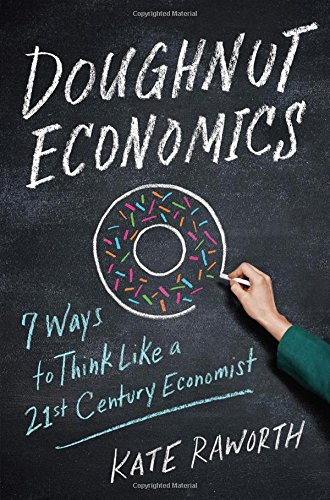
Doughnut Economics: Seven Ways to Think Like a 21st-Century Economist

Doughnut Economics: Seven Ways to Think Like a 21st-Century Economist

by Kate Raworth

star4.5

Raworth proposes a new economic model - the 'doughnut' bounded by a social floor and an ecological ceiling - and argues mainstream economics must shed its obsession with GDP growth, rational-actor assumptions, and equilibrium. She synthesizes systems thinking, behavioural economics, and ecological science into seven mindset shifts for a regenerative, distributive economy.

Published:
Pages:
320
Buy on Amazon

In the Conversation

In this collection, Doughnut Economics: Seven Ways to Think Like a 21st-Century Economist references 4 other books.

It draws on Thinking in Systems, Thinking, Fast and Slow and Nudge.

Scroll down to read the exact passages where other authors reference this book and what they say about it.

What This Book Draws On

4

The books Raworth references and why each one mattered to the argument.

Raworth credits Donella Meadows' Thinking in Systems with transforming her view of economics and builds her feedback-loop and leverage-point framework directly on Meadows' systems-dynamics approach

Thinking in Systems

References

Thinking in Systems

by Donella Meadows

Buy

Raworth cites Kahneman's work on cognitive biases to demolish the 'rational economic man' caricature, arguing economics must be rebuilt around System 1 thinking and bounded rationality

Thinking, Fast and Slow

References

Thinking, Fast and Slow

by Daniel Kahneman

Buy

Raworth engages with Thaler and Sunstein's Nudge literature to argue choice architecture and social norms should replace the assumption of perfectly self-interested maximizers

Nudge

References

Nudge

by Richard Thaler

Buy

Raworth builds on the Acemoglu-Robinson institutional analysis in Why Nations Fail to argue that economic outcomes are shaped by political choices about rules, not natural laws

Why Nations Fail

References

Why Nations Fail

by Daron Acemoglu and James A. Robinson

Buy

What Other Authors Say About It

No books citing this title yet.

Intellectual Lineage

How ideas flow through the citation network. Ancestors are books this title builds on; descendants are books that build on it.

Unexpected Connections

Books from completely different categories that share citation overlap with this one. These are the reads you would not find by browsing a single shelf.

If you liked this, try

Books with the highest citation overlap within the same categories.

Citation Network

This book and its direct connections. Hover a node to see its title, click to visit.

Books this book cites
Books that cite this book
Larger dot = more connections
Thinking, Fast and Slow

Hover a node to highlight its connections. Click to open the book page. Node size reflects total citation links.