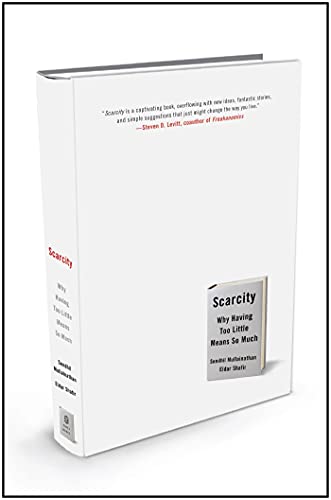
Scarcity
by Sendhil Mullainathan
Mullainathan shows scarcity captures the mind, creating tunnel vision that leads to worse decisions. Poverty isn't just a lack of resources - it's a cognitive tax that perpetuates itself.
- Published:
- Pages:
- 304

by Sendhil Mullainathan
Mullainathan shows scarcity captures the mind, creating tunnel vision that leads to worse decisions. Poverty isn't just a lack of resources - it's a cognitive tax that perpetuates itself.
In this collection, Scarcity references 2 other books.
It draws on Thinking, Fast and Slow and Nudge.
Scroll down to read the exact passages where other authors reference this book and what they say about it.
The books Mullainathan references and why each one mattered to the argument.
Mullainathan references Kahneman on cognitive bandwidth and biases.
Mullainathan references Thaler's Nudge on scarcity and choice architecture.
No books citing this title yet.
How ideas flow through the citation network. Ancestors are books this title builds on; descendants are books that build on it.
Directly cites
Books from completely different categories that share citation overlap with this one. These are the reads you would not find by browsing a single shelf.

Doughnut Economics: Seven Ways to Think Like a 21st-Century Economist
Kate Raworth

Laws of UX: Using Psychology to Design Better Products & Services
Jon Yablonski

The Filter Bubble: What the Internet Is Hiding from You
Eli Pariser

Atomic Habits
James Clear

Tools of Titans
Tim Ferriss

Hooked
Nir Eyal
Books with the highest citation overlap within the same categories.

Thinking in Bets
Annie Duke
2 shared citations
Misbehaving
Richard Thaler
2 shared citations
Noise
Daniel Kahneman
2 shared citations
Doughnut Economics: Seven Ways to Think Like a 21st-Century Economist
Kate Raworth
2 shared citations
Alchemy: The Dark Art and Curious Science of Creating Magic in Brands, Business, and Life
Rory Sutherland
2 shared citations
Risk Savvy: How to Make Good Decisions
Gerd Gigerenzer
2 shared citationsThis book and its direct connections. Hover a node to see its title, click to visit.
Hover a node to highlight its connections. Click to open the book page. Node size reflects total citation links.