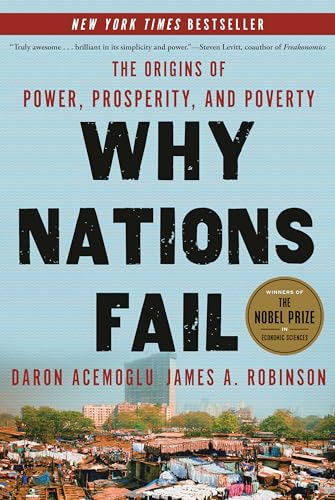
Why Nations Fail

Why Nations Fail

by Daron Acemoglu and James A. Robinson

star4.5

Acemoglu and Robinson argue that the stark prosperity gap between nations is driven not by geography, culture, or ignorance but by the distinction between inclusive and extractive political and economic institutions. Their sweeping comparative history, built on pairs like Nogales Arizona/Sonora and North/South Korea, claims that elites who monopolize power lock in poverty while pluralistic institutions create self-reinforcing prosperity.

Published:
Pages:
529
Buy on Amazon

In the Conversation

In this collection, Why Nations Fail references 3 other books and is cited by 5 other books.

It draws on Guns, Germs, and Steel, The Descent of Man and The Rise and Fall of the Third Reich.

It’s picked up by Doughnut Economics: Seven Ways to Think Like a 21st-Century Economist, The Silk Roads: A New History of the World and Savage Continent: Europe in the Aftermath of World War II and 2 others.

Scroll down to read the exact passages where other authors reference this book and what they say about it.

What People Say

Why Nations Fail is one of the most debated books in political economy, praised for its bold institutional thesis and challenged by historians who find it too neat. Kate Raworth builds on the Acemoglu-Robinson analysis in Doughnut Economics to argue that economic outcomes are shaped by political choices, not natural laws, while Joseph Henrich's The WEIRDest People in the World complements it by showing how psychological shifts preceded and enabled the inclusive institutions Acemoglu and Robinson describe.

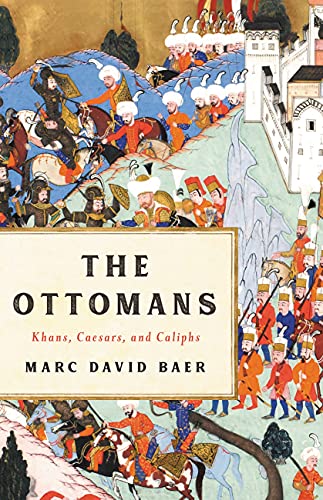
Not everyone is persuaded -- Peter Frankopan's The Silk Roads challenges the thesis by demonstrating that control of trade routes, not just institutions, determined which societies flourished, and Marc David Baer complicates the framework with the Ottoman Empire's mix of religious inclusion and dynastic extraction. The book is valued for giving readers a powerful single-variable explanation for global inequality, though critics note that very power makes it reductive.

What Why Nations Fail Draws On

3

The books Robinson references and why each one mattered to the argument.

Why Nations Fail is structured as a direct counterargument to Diamond's Guns, Germs, and Steel; Acemoglu and Robinson devote the opening chapters to refuting the geography hypothesis and thank Diamond in the acknowledgements for the ongoing debate.

Guns, Germs, and Steel

References

Guns, Germs, and Steel

by Jared Diamond

Buy

They draw on Darwin's Descent of Man framework of human cooperation and competition to ground their claim that institutions, not biological endowments, explain divergence.

The Descent of Man

References

The Descent of Man

by Charles Darwin

Buy

Acemoglu and Robinson cite Shirer's Rise and Fall of the Third Reich when analyzing how extractive institutions in interwar Germany created conditions for catastrophic political breakdown.

The Rise and Fall of the Third Reich

References

The Rise and Fall of the Third Reich

by William Shirer

Buy

What Other Authors Say About It

5

The exact passages where other authors bring up “Why Nations Fail” and what they take from it.

Challenges the institutional thesis of Why Nations Fail by showing that control of trade routes, not just inclusive institutions, determined which societies became rich and powerful across two millennia

Complicates Why Nations Fail by showing an empire that combined religiously inclusive administration (the millet system) with extractive dynastic rule, producing both resilience and eventual paralysis

Intellectual Lineage

How ideas flow through the citation network. Ancestors are books this title builds on; descendants are books that build on it.

Unexpected Connections

Books from completely different categories that share citation overlap with this one. These are the reads you would not find by browsing a single shelf.

If you liked this, try

Books with the highest citation overlap within the same categories.

Citation Network

This book and its direct connections. Hover a node to see its title, click to visit.

Books this book cites
Books that cite this book
Larger dot = more connections
Why Nations FailGuns, Germs, and SteelThe Rise and Fall of the…

Hover a node to highlight its connections. Click to open the book page. Node size reflects total citation links.