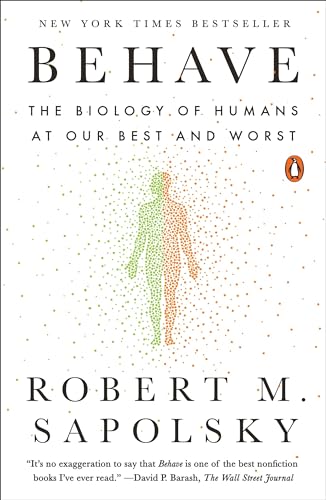
Behave
by Robert Sapolsky
star4.4
Sapolsky traces every human behaviour, from aggression to empathy, through biology, from the millisecond before an act back to evolutionary pressures millions of years ago.
- Published:
- Pages:
- 800
by Robert Sapolsky
Sapolsky traces every human behaviour, from aggression to empathy, through biology, from the millisecond before an act back to evolutionary pressures millions of years ago.
In this collection, Behave references 4 other books and is cited by 7 other books.
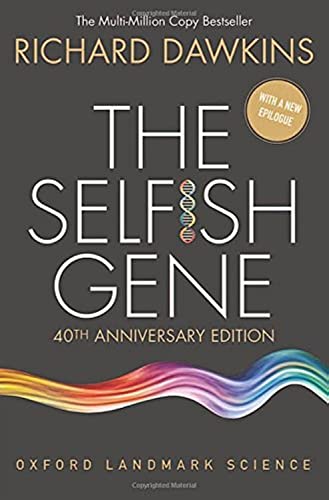
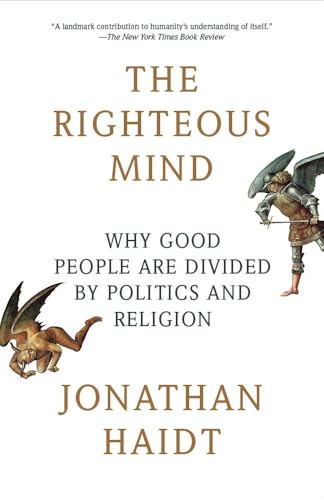
It draws on The Selfish Gene, Thinking, Fast and Slow and The Righteous Mind.
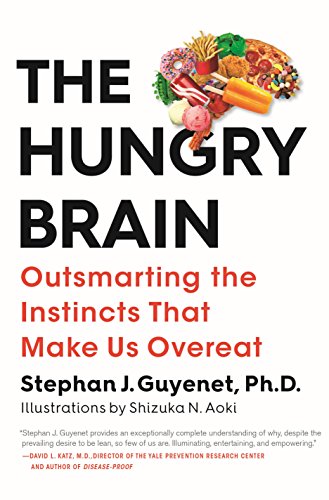
It’s picked up by The Hungry Brain: Outsmarting the Instincts That Make Us Overeat, The Circadian Code: Lose Weight, Supercharge Your Energy, and Transform Your Health from Morning to Midnight and The Longevity Diet: Discover the New Science Behind Stem Cell Activation and Regeneration to Slow Aging, Fight Disease, and Optimize Weight and 4 others.
Scroll down to read the exact passages where other authors reference this book and what they say about it.
Behave is widely regarded as the most ambitious single-volume attempt to explain human behavior through biology, and other scientists regularly lean on Sapolsky's work in their own books. Stephan Guyenet draws on his dopamine research to explain compulsive eating, Satchin Panda uses his cortisol work to ground circadian health claims, and Will Storr credits his neurobiology-and-behavior integration as the backbone for understanding why stories feel true. Readers praise the book's remarkable scope -- tracing every action from the millisecond before it happens back through evolution -- though many warn it is dense and demanding, essentially a graduate-level textbook disguised as popular science.
Bill Bryson draws on it for his nervous-system chapters in The Body, and Ed Yong's An Immense World treats it as a complementary perspective on how brains process the world. For readers willing to invest the time, it is consistently recommended as the most complete map of why humans do what they do.
The books Sapolsky references and why each one mattered to the argument.
Sapolsky discusses Dawkins's gene-centric evolution.
Behave references Kahneman on rapid judgements vs deliberate reasoning.
Sapolsky engages with Haidt's Righteous Mind on biological morality.
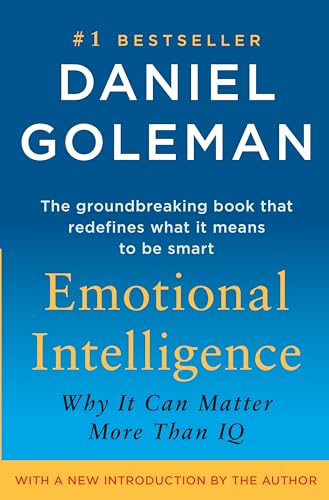
Behave discusses Goleman's work on empathy.
The exact passages where other authors bring up “Behave” and what they take from it.
Guyenet cites Sapolsky's neurobiology work on dopamine and reward to explain why food cues trigger compulsive eating in modern environments
Panda draws on Sapolsky's work on circadian-regulated stress hormones to explain why cortisol rhythms dictate when the body best handles glucose
Longo draws on Sapolsky's research on stress hormones and ageing to explain how chronic cortisol elevation accelerates cellular senescence
Richtel draws on Sapolsky's work on stress biology to explain how chronic cortisol elevation suppresses T-cell function and raises infection risk
Storr leans on Sapolsky's Behave-style integration of neurobiology and behavior to show how status, tribe, and hormones shape the conflicts that make stories feel true
Sapolsky's Behave is drawn on in Bryson's discussion of the brain and human behavior, providing the biology-of-behavior backdrop for his nervous-system chapters.
How ideas flow through the citation network. Ancestors are books this title builds on; descendants are books that build on it.
Directly cited by
2 steps forward
Books from completely different categories that share citation overlap with this one. These are the reads you would not find by browsing a single shelf.
Books with the highest citation overlap within the same categories.
This book and its direct connections. Hover a node to see its title, click to visit.
Hover a node to highlight its connections. Click to open the book page. Node size reflects total citation links.