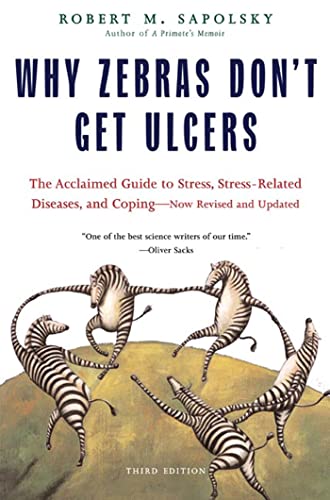
Why Zebras Don't Get Ulcers: The Acclaimed Guide to Stress, Stress-Related Diseases, and Coping

Why Zebras Don't Get Ulcers: The Acclaimed Guide to Stress, Stress-Related Diseases, and Coping

by Robert Sapolsky

star4.6

Sapolsky argues that humans uniquely suffer stress-related disease because we activate the fight-or-flight response over chronic psychological threats that zebras never face. He traces how sustained glucocorticoid elevation damages the cardiovascular, immune, reproductive, and nervous systems.

Published:
Pages:
560
Buy on Amazon

In the Conversation

In this collection, Why Zebras Don't Get Ulcers: The Acclaimed Guide to Stress, Stress-Related Diseases, and Coping references 4 other books and is cited by 6 other books.

It draws on The Selfish Gene, Man's Search for Meaning and The Origin of Species.

It’s picked up by Attached: The New Science of Adult Attachment and How It Can Help You Find--and Keep--Love, Hold Me Tight: Seven Conversations for a Lifetime of Love and Mating in Captivity: Unlocking Erotic Intelligence and 3 others.

Scroll down to read the exact passages where other authors reference this book and what they say about it.

What People Say

Why Zebras Don't Get Ulcers is the go-to reference on stress biology for authors across psychology, parenting, and relationships. Amir Levine and Rachel Heller cite Sapolsky's primate research in Attached to argue that the human need for a secure base is biologically wired, while Sue Johnson draws on his stress physiology to explain why partner disconnection triggers full-body threat responses. Paul Tough quotes Sapolsky's insight that humans uniquely activate emergency stress responses chronically rather than acutely, using it to explain how toxic stress damages children's developing brains.

Mark Wolynn uses Sapolsky's glucocorticoid research to ground the epigenetic inheritance of trauma in measurable physiology. Readers praise the book's rare combination of rigorous science and genuinely funny writing, though some find the later chapters on coping strategies thinner than the biological explanations. It is consistently recommended as the single best book for understanding what stress actually does to the body and why modern life makes it worse.
What This Book Draws On

4

The books Sapolsky references and why each one mattered to the argument.

Sapolsky builds on Dawkins's gene's-eye view to explain why the stress response evolved as an acute survival tool, now misfiring under chronic modern pressures

The Selfish Gene

References

The Selfish Gene

by Richard Dawkins

Buy

Sapolsky cites Frankl's observations from the camps to illustrate that perceived control and meaning are the decisive moderators of whether stress becomes pathological

Man's Search for Meaning

References

Man's Search for Meaning

by Viktor Frankl

Buy

Sapolsky grounds his framework in Darwinian adaptation, showing that cortisol systems were shaped for brief physical threats, not sustained social anxiety

The Origin of Species

References

The Origin of Species

by Charles Darwin

Buy

Sapolsky's thesis is a founding text of the Darwinian-medicine tradition Nesse develops, treating modern disease as evolutionary mismatch

Why We Get Sick

References

Why We Get Sick

by Randolph M. Nesse

Buy

What Other Authors Say About It

6

The exact passages where other authors bring up “Why Zebras Don't Get Ulcers: The Acclaimed Guide to Stress, Stress-Related Diseases, and Coping” and what they take from it.

Intellectual Lineage

How ideas flow through the citation network. Ancestors are books this title builds on; descendants are books that build on it.

Unexpected Connections

Books from completely different categories that share citation overlap with this one. These are the reads you would not find by browsing a single shelf.

If you liked this, try

Books with the highest citation overlap within the same categories.

Citation Network

This book and its direct connections. Hover a node to see its title, click to visit.

Books this book cites
Books that cite this book
Larger dot = more connections
Man's Search for MeaningThe Selfish GeneThe Origin of Species

Hover a node to highlight its connections. Click to open the book page. Node size reflects total citation links.