Reading Guide

Start a Business

From first idea to first paying customers, without the mythology

Most startup advice confuses survival with strategy. This reading path is sequenced to mirror the actual journey of building a business: first you learn to validate that anyone wants what you plan to build, then you figure out how to reach them and grow, and finally you learn to build the organisation that can sustain what you have started. The order matters because premature scaling is the most common way startups die.

Who is this for

This guide is for aspiring founders who want to build a real business, not just fantasise about one. It is equally useful for first time entrepreneurs wrestling with an idea and for people inside larger organisations who need to think like founders. Skip this if you are looking for motivational stories; this path is about method, not inspiration.

Time to complete

About 7 weeks at one book per week

Prerequisites

None, though having a specific business idea in mind will make every book twice as useful

Phase 1: Validate Before You Build

The graveyard of startups is full of beautiful products nobody wanted. These books teach you to find real problems and test real demand before you commit serious time or money.

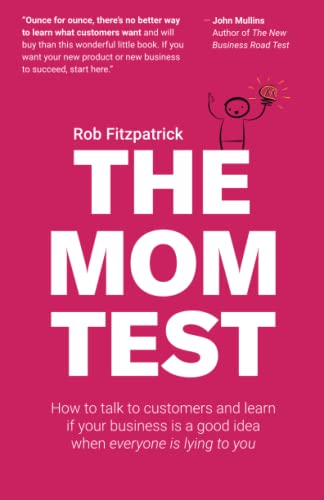
  1. The Mom Test1

    The Mom Test

    by Rob Fitzpatrick

    Fitzpatrick's slim, practical book solves the single biggest problem first time founders face: they ask potential customers leading questions and mistake politeness for validation. This belongs first because everything else in the guide is wasted effort if you are building something nobody needs. It is short enough to read in a weekend and will save you months of misdirection.

    Key takeaway

    Never ask people if they would buy your product; instead, ask about their lives, their problems, and how they currently solve them, and let the data tell you whether to proceed.

  2. The Lean Startup2

    The Lean Startup

    by Eric Ries

    Ries codified the build, measure, learn loop that has become the default methodology for startups. It provides the overall framework for iterating quickly and killing ideas that are not working. Reading this after The Mom Test means you arrive with a healthy scepticism about customer conversations, which makes you a sharper practitioner of lean methods.

    Key takeaway

    Validated learning is the only meaningful measure of progress for a startup; everything else, including revenue, can be a vanity metric if you are not learning what drives it.

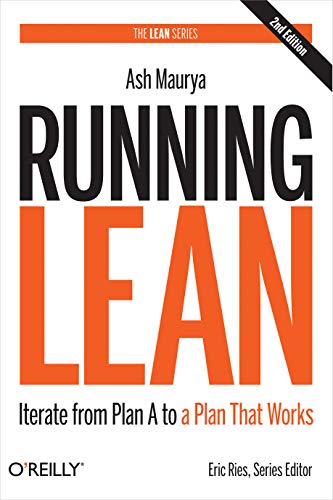
  3. Running Lean3

    Running Lean

    by Ash Maurya

    Maurya takes the Lean Startup philosophy and turns it into a step by step playbook with specific canvases, metrics, and decision points. It is more prescriptive and practical than Ries, which is exactly what you need when you are actually doing the work. It fills the gap between theory and execution.

    Key takeaway

    Document your riskiest assumptions explicitly, then design the cheapest possible experiments to test them in order of risk, not in order of what is fun to build.

Phase 2: Find Your Market and Grow

Having a validated product is not enough. You need to understand where your business fits in the competitive landscape and how to reach customers at scale without burning through your resources.

  1. Zero to One4

    Zero to One

    by Peter Thiel

    Thiel's contrarian framework forces you to ask whether you are creating something genuinely new or merely competing in an existing market. This question is existential for any startup because the answer determines your entire strategy. It belongs at the start of the growth phase because it reframes how you think about competition, monopoly, and defensibility.

    Key takeaway

    The most valuable businesses create new categories rather than fighting for share in existing ones; competition is for losers because it erodes the profits that fund everything else.

  2. $100M Offers5

    $100M Offers

    by Alex Hormozi

    Hormozi is ruthlessly practical about pricing, packaging, and making offers so compelling that customers feel foolish saying no. This book bridges the gap between having a product people want and actually getting them to pay for it. It is written in blunt, no nonsense language and provides immediately applicable frameworks for structuring offers.

    Key takeaway

    Your offer is not your product; it is the combination of the product, the price, the bonuses, the guarantee, and the scarcity that together make the decision obvious for your ideal customer.

Phase 3: Build the Organisation

Startups do not fail only from bad products; they fail from bad teams, bad culture, and founders who cannot make the transition from doing to leading. These books cover the hardest part: building something that outlasts the founder's individual effort.

  1. The Hard Thing About Hard Things6

    The Hard Thing About Hard Things

    by Ben Horowitz

    Horowitz wrote the honest book about the parts of entrepreneurship that nobody else talks about: firing friends, managing your own psychology during crises, and making decisions with incomplete information. It is the antidote to the glamorised version of startup life. Reading this during the organisation building phase prepares you for the emotional reality of scaling.

    Key takeaway

    There is no recipe for the hard things; what matters is making decisions quickly, being honest about bad news, and accepting that the job of the CEO is to do the things that only the CEO can do.

  2. No Rules Rules7

    No Rules Rules

    by Reed Hastings

    Hastings and Meyer explain how Netflix built a culture of radical candour, talent density, and minimal process. Whether or not you adopt their exact approach, the book forces you to think deliberately about what kind of organisation you are building. It belongs late in the guide because culture questions only become urgent once you start hiring.

    Key takeaway

    High performance cultures are built on trust, not rules; when you hire exceptional people and give them context instead of control, you can remove most of the processes that slow organisations down.

Common mistakes to avoid

  • Do not write a business plan before talking to customers; the plan will be fiction and you will anchor to it emotionally, making it harder to pivot when the data says you should.

  • Avoid reading fundraising and scaling books before you have product market fit; premature knowledge of growth tactics makes founders optimise for metrics instead of learning.

  • Do not mistake reading about entrepreneurship for doing entrepreneurship; cap your reading at one book per week and spend the rest of your time executing.

  • Beware of survivorship bias in founder memoirs; the strategies that worked for one company in one market at one time may be irrelevant or actively harmful in your context.

  • Do not hire ahead of demand; the most common way funded startups die is by scaling the team before the product market fit is proven, which multiplies burn rate without multiplying learning.

How to work through this guide

The minimum viable reading list from this guide is The Mom Test, The Lean Startup, and The Hard Thing About Hard Things. Those three cover the full arc from validation through execution to leadership. If you are pre idea, start with Zero to One to sharpen your thinking about what is worth building. If you already have traction and need to grow, jump straight to the Phase 2 and Phase 3 books. The single most important thing is to read actively: treat each book as a workbook and apply its frameworks to your own situation the same week you read it.

BookGraph is an Amazon Associate. If you buy through the links above we may earn a small commission at no extra cost to you. All book selections and editorial reasoning are our own.

Other Reading Guides