Reading Guide

Lead With Courage

The leadership canon for people who actually have to do it

Every book on this list has been battle-tested by someone who had to make hard calls with their name on the line. The list is deliberately diverse: a motivational speaker, a vulnerability researcher, a Navy SEAL, a Silicon Valley CEO, a nuclear submarine captain, and two historians. They disagree on style but converge on substance. Start with whichever voice you trust most and work outward.

Who is this for

New or experienced managers, founders, team leads, or anyone who has recently been given responsibility for other people and realised that technical skill is not enough. Not for people looking for abstract theory. Every book here was written by someone who had to make hard calls.

Time to complete

About 10 weeks. This is the longest guide and several books are substantial. Consider reading two at a time from different sections.

Prerequisites

Some management experience helps. If you have never managed anyone, read "The Manager's Path" by Camille Fournier first.

Finding Your Leadership Philosophy

Start with the big questions. Why do you lead? What kind of leader do you want to be? These books provide frameworks for thinking about purpose, vulnerability, and accountability.

  1. Start with Why1

    Start with Why

    by Simon Sinek

    The most accessible starting point. Sinek provides a short framework for articulating the underlying purpose that every leader needs. The "why" concept is overused in corporate settings, but the core insight is valid: people follow leaders who can explain what they believe, not just what they do.

    Key takeaway

    Start with why. People do not buy what you do, they buy why you do it. As a leader, your job is to articulate the cause that the team serves, not just the tasks it performs.

  2. Dare to Lead2

    Dare to Lead

    by Brene Brown

    The emotional half of leadership. Brown argues that vulnerability is not weakness but courage, and that the most effective leaders are those who can sit with discomfort rather than avoiding it. Read second to balance the strategic framing of Sinek with the interpersonal demands of actually doing the job.

    Key takeaway

    Courageous leadership requires vulnerability. You cannot build trust while wearing armour. The willingness to have difficult conversations, admit mistakes, and ask for help is what separates leaders who are respected from those who are merely obeyed.

Tactical Leadership

Philosophy is necessary but not sufficient. These books provide concrete tools for the daily work of leading people.

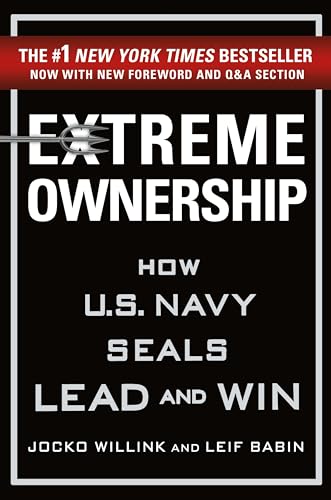
  1. Extreme Ownership3

    Extreme Ownership

    by Jocko Willink

    A military counterweight. Willink and Babin provide a bluntly tactical leadership framework built on total ownership of outcomes. Useful when the softer books start feeling too abstract. Their core principle: if your team fails, it is your fault. No excuses, no blame.

    Key takeaway

    Extreme ownership means you own every outcome, good or bad. If your team does not understand the mission, that is your failure to communicate. If they lack resources, that is your failure to prioritise. The leader is never the victim.

  2. Radical Candor4

    Radical Candor

    by Kim Scott

    The book to read before your next difficult feedback conversation. Scott provides a 2x2 framework (care personally, challenge directly) that gives feedback conversations a structure. Concrete, practical, hard to forget once you have read it.

    Key takeaway

    Radical candour is caring personally while challenging directly. Ruinous empathy (caring but not challenging) is the most common leadership failure. Give feedback within 48 hours, in private, starting with what you observed and how it landed.

  3. Leaders Eat Last5

    Leaders Eat Last

    by Simon Sinek

    For when the question shifts from "how do I lead this person" to "how do I build a team where leadership becomes unnecessary". Marquet reversed the leader-follower model on a nuclear submarine by pushing decision-making authority down to the people with the information.

    Key takeaway

    Give control, not orders. Instead of "tell me what to do", train your team to say "I intend to..." and then approve or redirect. Competence and clarity must increase as control is pushed downward.

The Long View

Leadership is not just a skill but a way of seeing the world. These books provide the philosophical depth and historical perspective that separates good leaders from great ones.

  1. The Infinite Game6

    The Infinite Game

    by Simon Sinek

    A philosophical capstone on what leadership is even for. Sinek argues that great leaders play the infinite game: they optimise for the organisation's long-term survival, not short-term wins. Best read after a few of the more tactical books, not before.

    Key takeaway

    Finite players play to win. Infinite players play to keep playing. The leaders who build enduring organisations are those who prioritise a just cause, trusting teams, and worthy rivals over quarterly metrics.

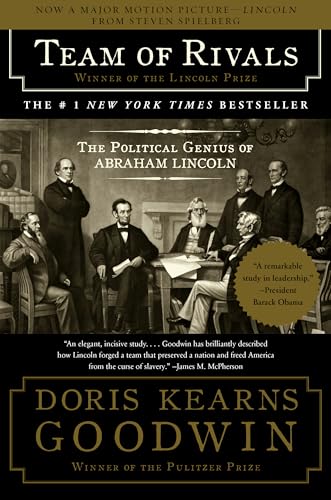
  2. Team of Rivals: The Political Genius of Abraham Lincoln7

    Team of Rivals: The Political Genius of Abraham Lincoln

    by Doris Kearns Goodwin

    A historical case study so good it changes how you think about every chapter above. Goodwin weaves together Lincoln, both Roosevelts, and LBJ to show how very different leadership styles can each be effective when matched to the right moment. Slow reading but worth it.

    Key takeaway

    There is no single leadership style that works for all situations. Empathy, ambition, resilience, and vision each have their season. The greatest leaders are those who can read the moment and adapt.

Common mistakes to avoid

  • Reading leadership books instead of leading. The most important leadership skill is the willingness to make decisions with incomplete information. No book teaches that. Only practice does.

  • Adopting a single framework as gospel. Extreme Ownership and Radical Candor and Servant Leadership all work, but not in every situation. Beware of any book that claims to have the one answer.

  • Confusing leadership with authority. The best leaders on this list (Lincoln, Marquet) actively gave away power. If your leadership style requires constant control, revisit your assumptions.

  • Ignoring your own wellbeing. Burnout is not a badge of honour. Read the "Handle Stress & Anxiety" guide alongside this one.

How to work through this guide

No reader needs all seven books. The first three give you a working philosophy, a tactical playbook, and a feedback framework. That is enough to lead well. The remaining books are for readers who already lead and want depth, not breadth. If you only read one, read Radical Candor. It will improve your next conversation, which is more than most leadership books can claim.

BookGraph is an Amazon Associate. If you buy through the links above we may earn a small commission at no extra cost to you. All book selections and editorial reasoning are our own.

Other Reading Guides