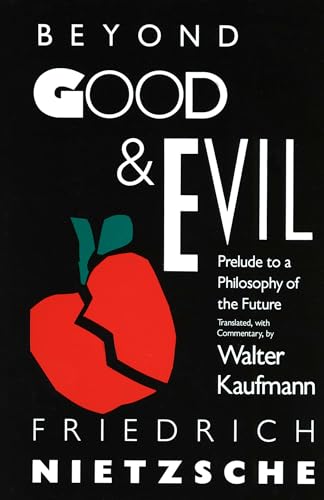
Beyond Good and Evil
by Friedrich Nietzsche
star4
Nietzsche attacks conventional morality as a system built by the weak to restrain the strong. He demands that philosophers create new values rather than accept inherited ones.
- Published:
- Pages:
- 240
by Friedrich Nietzsche
Nietzsche attacks conventional morality as a system built by the weak to restrain the strong. He demands that philosophers create new values rather than accept inherited ones.
In this collection, Beyond Good and Evil is cited by 11 other books.
It’s picked up by The Consolations of Philosophy, Existentialism Is a Humanism and The Myth of Sisyphus and 8 others.
Scroll down to read the exact passages where other authors reference this book and what they say about it.
Beyond Good and Evil is treated as a pivotal text by existentialists, Stoics, and Zen practitioners alike, which gives some sense of its reach. Sartre engages with Nietzsche's 'God is dead' declaration in Existentialism Is a Humanism, Camus names him among the 'evil geniuses of contemporary Europe' in The Rebel, and Sarah Bakewell traces the entire existentialist tradition back to him in At the Existentialist Cafe. Alan Watts finds in Nietzsche a Western parallel to Zen's dissolution of moral dualism, while Simone de Beauvoir names him alongside Hegel and Kierkegaard as a direct influence.
Readers praise its aphoristic intensity and intellectual daring, though many find Nietzsche's style deliberately provocative and sometimes difficult to distinguish from the positions he is critiquing. It is best approached as a book that rewards rereading -- and that virtually every major 20th-century philosopher felt compelled to respond to.
No verified citations found yet.
The exact passages where other authors bring up “Beyond Good and Evil” and what they take from it.
De Botton devotes chapter to Nietzsche.
Sartre engages with Nietzsche's God is dead.
Camus discusses Nietzsche's eternal recurrence.
Bakewell traces existentialism to Nietzsche.
Nietzsche is among the modern critics Farnsworth engages with in the concluding chapter on Stoicism and its critics
Watts engages Nietzsche's critique of Western moral dualism as a parallel to Zen's dissolution of the subject-object split, citing Beyond Good and Evil's project of going beyond conventional moral categories
How ideas flow through the citation network. Ancestors are books this title builds on; descendants are books that build on it.
Directly cited by
Books from completely different categories that share citation overlap with this one. These are the reads you would not find by browsing a single shelf.
Books with the highest citation overlap within the same categories.
This book and its direct connections. Hover a node to see its title, click to visit.
Hover a node to highlight its connections. Click to open the book page. Node size reflects total citation links.